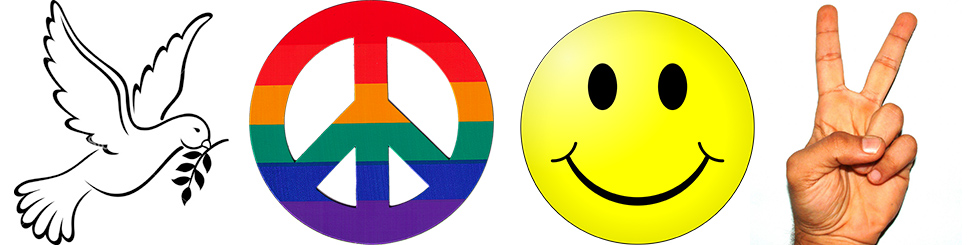
Peace Symbol History
Have you ever wondered where the peace symbol came from? The peace symbol combines a circle, a vertical line, and downward sloping lines. Throughout history the peace symbol was not always used in the spirit of love and service to humanity. For this reason, the Teach Peace Foundation logo is not a traditional peace symbol but people around the world holding hands. A popular explanation of the peace symbol is that Gerald Herbert Holtom (1914 - 1985) created this symbol on February 21, 1958.1 At that time Holtom worked with the Direct Action Committee against Nuclear War. Holtom was a dedicated peacemaker and graduate of the Royal College of Arts. During World War II he worked on a farm in England as a conscientious objector. The BBC quoted Holtom, "I drew myself: the representative of an individual in despair, with hands palm outstretched outwards and downwards in the manner of Goya's peasant before the firing squad." The picture on the right shows one of Holtom's first sketches of the peace symbol. Opponents of the peace movement sometimes are thrilled to see the hands downward which symbolizes peasants being killed by a firing squad. Bertrand Russell (1872 - 1970), a philosopher, historian, mathematician, and a member of the Direct Action Committee against Nuclear War, supported Holtom's claim and aggressively promoted the arms down symbol. The arms down peace sign made its first public appearance in the United Kingdom during the 1958 Easter weekend Direct Action Committee anti-nuclear march from London to Aldermaston. Russell was the march organizer responsible for placing the arms down peace symbol on buttons and banners. Russell downplayed his role and true interest in the peace symbol when he wrote, “It was invented by a member of our movement (Gerald Holtom) as the badge of the Direct Action Committee against Nuclear War, for the 1958 Aldermaston peace walk in England. It was designed from the naval code of semaphore, and the symbol represents the code letters for ND.'” The code ND for Nuclear Disarmament is shown on the right.4 The circle, representing the concept of total or complete, surrounds the N and D signifying total or complete nuclear disarmament. American journalist and playwright Herb Greer adds support for the Holtom explanation. He reported, “I was actually there on and before the first Aldermaston march for which it was created. I visited Holtom, I saw the original sketches and discussed it with him.” |
Presentations
Brainstorm
- Name of the festival
- Time
- Reason
- Preparations
- Actual Day
- Feelings
Outline
- Introduction
- Set the scene name, time/date/place of event/reason for celebrating
- Main Body
- First point
- preparations
- Second point
- description of the actual event (costumes / atmosphere / activities / food)
- explanation and reason
- Third point - feelings
- explanation and reason
- Conclusion
- Feelings/comments/final thoughts
Points to Consider
Compare.
- Describe an event/festival/celebration which takes place in your country.
- Describe an event/festival/celebration that you have attended and explain the impression it made on you.