Welcome to Lesson 0.3. The iTEP Listening section tests your ability to understand spoken English in academic and campus-life settings. A major challenge is that you will hear each audio clip only once. This means you can't just be a passive listener; you must become an active listener. In this lesson, we'll simulate the three parts of the listening test and introduce powerful note-taking strategies to help you capture and recall key information effectively. The goal is to turn listening into a proactive skill, not just a receptive one. Ready to tune in? 🎧
iTEP Listening: A Quick Overview
The Listening section is divided into three parts, each with a different format and type of question.
- Part 1: Short Conversations. Four short conversations between two speakers, each followed by one multiple-choice question.
- Part 2: Longer Conversation. One longer conversation (2-3 minutes), followed by 4-6 multiple-choice questions.
- Part 3: Lecture. One academic lecture (4-5 minutes), followed by 4-6 multiple-choice questions.
Listening Simulation
Now, let's experience each part. You will hear three audio clips. Listen carefully, as they will not be repeated. For the longer conversation and lecture, practice taking notes on a separate piece of paper. Don't worry about perfection; this is practice.
Part 1: Short Conversation
Listen to this short conversation. You don't need to take notes, just focus on understanding the gist of the interaction.
Part 2: Longer Conversation
Now, listen to a longer conversation. This time, try to take some notes. Focus on the main problem and the proposed solutions.
Part 3: Lecture
Finally, listen to this short academic lecture. This is where note-taking becomes essential. Try to capture the main ideas, key examples, and the overall structure of the lecture. Pay attention to transition words!
Strategy Focus: Effective Note-Taking
You can't write down everything. Trying to write verbatim is a common mistake that leads to missing the next point. The key is to take smart notes, not long notes. Your notes should be a tool to quickly recall information, not a perfect transcript.
Here are some core techniques:
- Use Abbreviations & Symbols: Shorten common words (e.g.,
w/for with,b/cfor because,&for and). Use symbols like arrows (→for cause-and-effect,↑for increase,↓for decrease). - Focus on Key Terms: Listen for nouns, verbs, dates, and names. These carry the main meaning. Don't worry about articles (a, an, the) or prepositions.
- Listen for Cues: Speakers use transition words to signal their structure. Words like First, Next, In contrast, For example, and In conclusion are like signposts telling you where the lecture is going. Mark them in your notes! A discrepancy between what you expect and what is said can also be a key point.
Mini-Lecture: Choosing Your Note-Taking Style
There are several methods for taking notes, but two are particularly useful for timed tests like the iTEP. Let's look at the pros and cons of each.
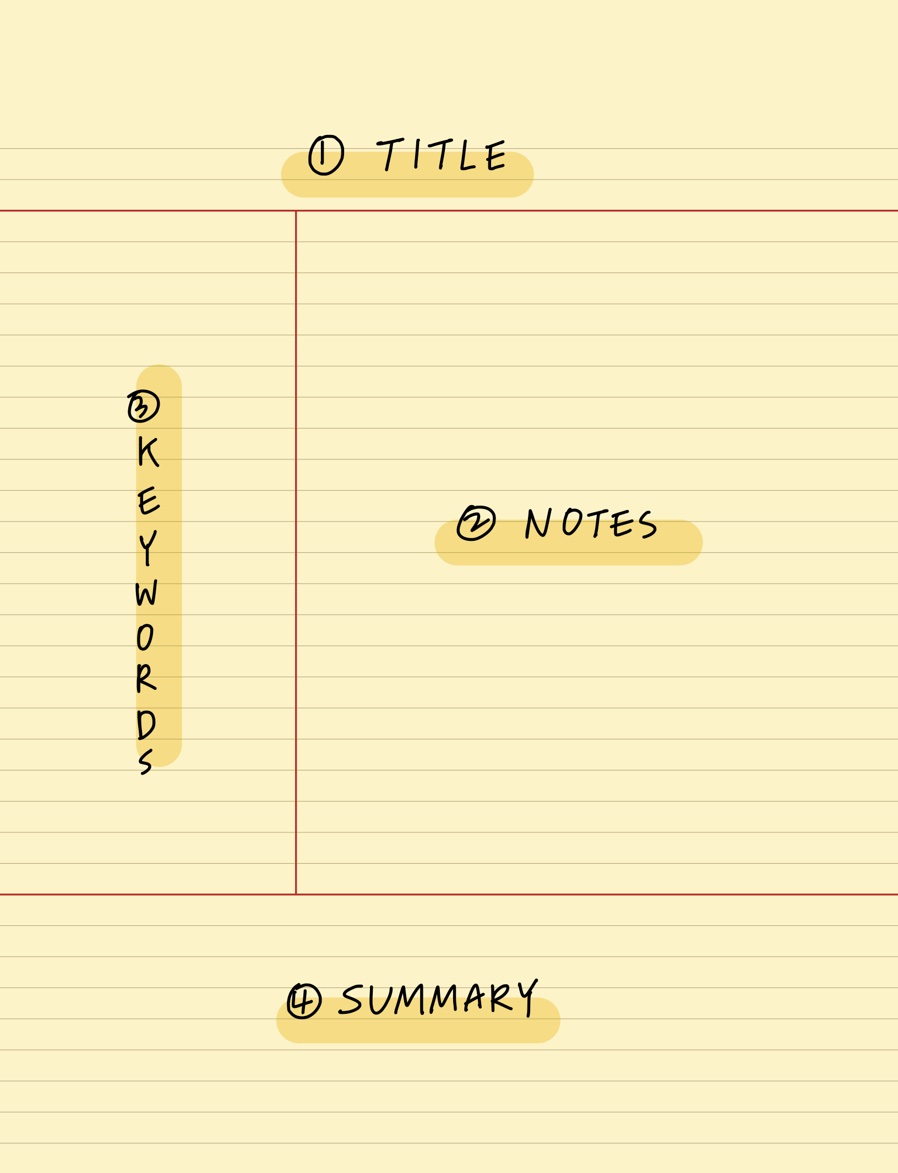
Cornell Note Taking
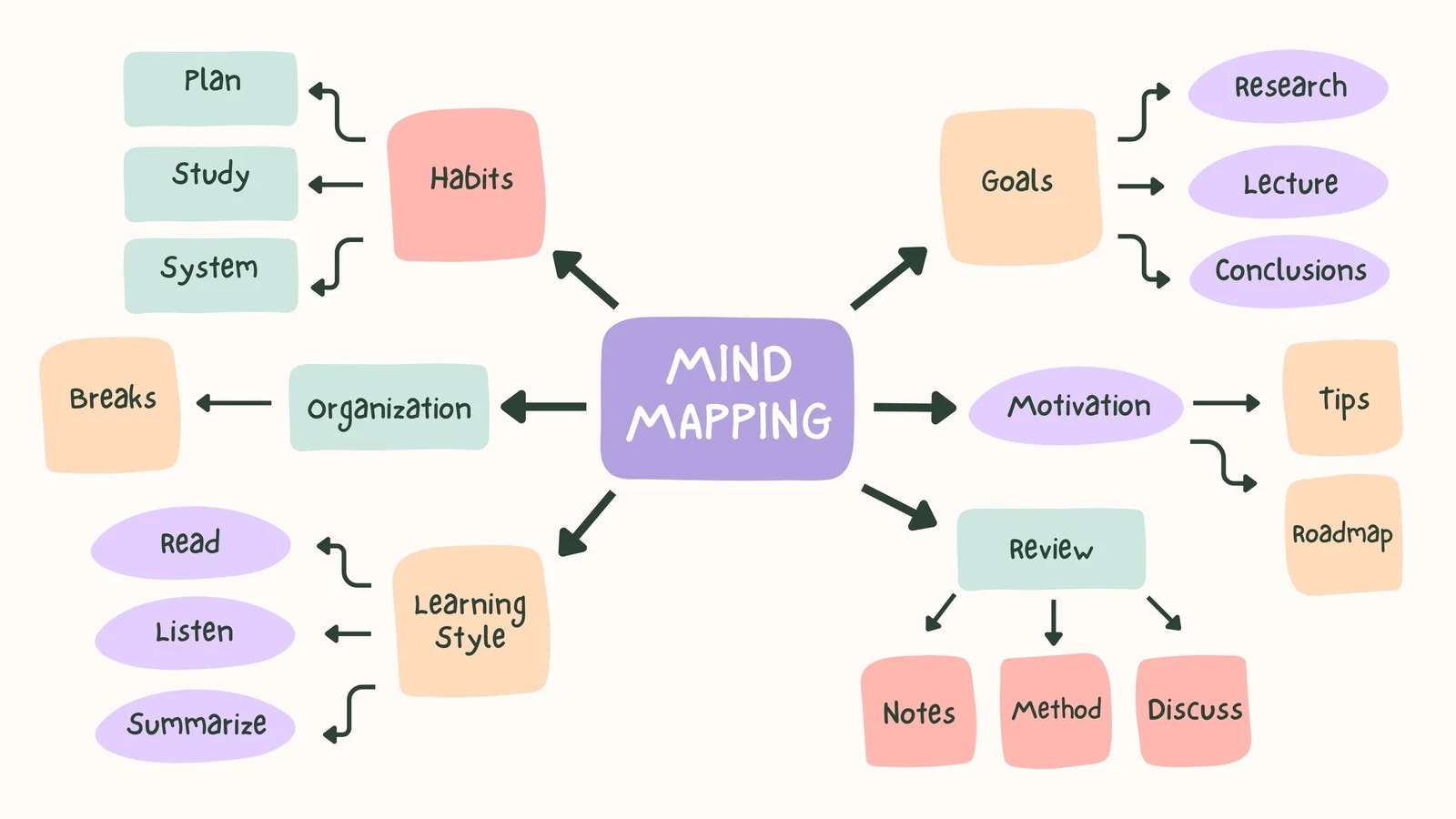
Mind Map
1. The Outline / Simplified Cornell Method
This method is linear and organized. You divide your page into two columns. The main, wider column on the right is for taking notes during the lecture. The smaller column on the left is for keywords, questions, or main ideas that you fill in immediately after the lecture ends.
- Pros:
- Very organized and sequential. Easy to review.
- Focuses on relationships between main ideas and details.
- The left column is excellent for quickly finding answers to specific questions.
- Cons:
- Can be rigid. If the speaker jumps between topics, your notes can get messy.
- Requires some discipline to set up and use correctly under pressure.
2. The Mind Map / Spider Diagram
This method is visual and flexible. You start with the central topic in the middle of the page. As the speaker introduces new ideas, you draw branches out from the center for each main point. You then add smaller sub-branches for details, examples, and keywords.
- Pros:
- Excellent for visual learners.
- Shows the relationship between ideas non-linearly.
- Very flexible; you can add information anywhere it fits. Easy to see the whole topic at a glance.
- Cons:
- Can become chaotic or difficult to read if you're not neat.
- May be less effective for capturing highly detailed, sequential information like a step-by-step process.
Which is better? There's no single right answer. It depends on your personal style and the nature of the lecture. Try both during your practice and see which one feels more natural and yields better results for you.
Speaking Activity: Summarize the Main Point
Now, look at the notes you took during the biomimicry lecture. Use only your notes to summarize the professor's main point. You will have 30 seconds to prepare and 45 seconds to speak. Your summary should be just one or two sentences. The goal is clarity and accuracy. Try to use some of the key vocabulary from the lecture.
Example prompts to guide your thinking:
- What was the central idea or definition presented?
- What was the main example used to illustrate this idea?