Welcome to the "Engine Room" of the iTEP exam. The Grammar (Structure) and Reading sections are foundational to your success. They test your core English knowledge and your ability to work efficiently under pressure. Today, we'll break down these sections, identify the question types, and practice key strategies like time management and the process of elimination. Think of this as your first diagnostic workout to see how the engine runs.
Grammar (Structure) Section
The Grammar section is a high-speed test of your ability to recognize correct and incorrect English structures. You'll have 10 minutes to answer 25 questions, which gives you only 24 seconds per question! The key is to be quick and decisive.
Two Question Types
The iTEP uses two types of multiple-choice grammar questions.
Type 1: Fill-in-the-Blank
This format presents a sentence with a missing word or phrase. Your task is to choose the option that correctly completes the sentence. These questions often test your knowledge of verb tenses, prepositions, and word forms.
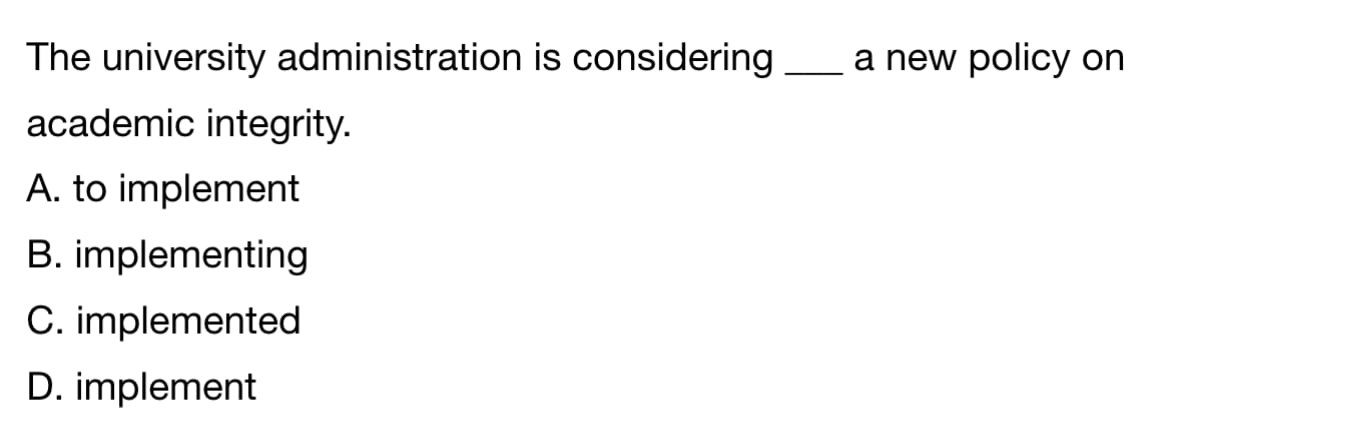
(Correct Answer: B. The verb 'considering' is followed by a gerund.)
Type 2: Error Identification
This format presents a sentence with four underlined words or phrases. You must identify which of the underlined parts is grammatically incorrect. These questions require a keen eye for common errors, especially with articles, subject-verb agreement, and prepositions.

(Correct Answer: B. The pronoun 'its' should be 'their' to agree with the plural noun 'findings'.)
Strategy Focus: Speed and Accuracy
With only 24 seconds per question, you can't afford to get stuck. Here’s the strategy:
- Read the sentence quickly to understand the context.
- If the answer is obvious, select it and move on.
- If you're unsure, use the process of elimination. Get rid of the choices you know are wrong.
- If you're still stuck after 15-20 seconds, make your best guess and move on. It's better to answer all questions than to spend too much time on one difficult one.
Reading Section
The Reading section tests your ability to understand academic texts. It is divided into two parts, featuring passages of different lengths and complexity.
Part 1: Short Passage
This part has one short passage of about 250 words, followed by 4 multiple-choice questions.
Part 2: Long Passage
This part has one longer passage of about 450 words, followed by 6 multiple-choice questions.
Four Main Question Types
Across both parts, you'll encounter four main types of questions:
- Main Idea: Asks about the primary topic or purpose of the passage. Look for a sentence that summarizes the entire text.
- Detail: Asks for specific information stated directly in the text. You'll need to find the exact sentence that contains the answer.
- Inference: Asks you to draw a conclusion based on information in the passage. The answer isn't stated directly, but it's strongly implied.
- Vocabulary-in-Context: Asks for the meaning of a word as it's used in the passage. Use the surrounding sentences as clues to determine the correct definition.
Strategy Focus: Skimming vs. Scanning
To manage your time effectively, you need to master two reading techniques. Watch this video to understand the difference between skimming (reading quickly for a general overview) and scanning (looking for specific information).
Reading Techniques: Skimming and Scanning
This video explains how to use skimming and scanning to read more efficiently.