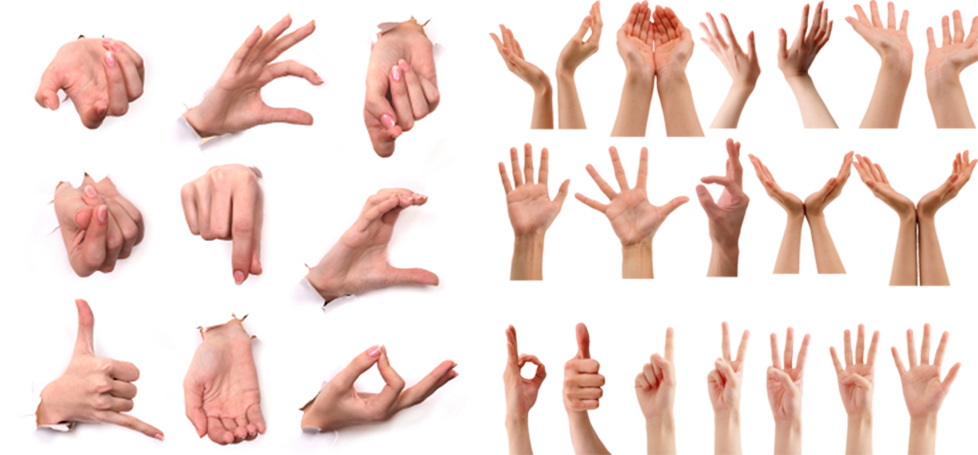
There are two kinds of gestures. First, there are the hand movements that emphasize the words–the posture of the hand as it beats the air will tell you something about the mood of the person. Then there are the symbolic gestures or emblematic gestures that have a meaning or provide a piece of information. With the case of the thumbs up or the raised middle finger, the gestures are taking the place of verbal communication. TheyÂ’re not ancient symbols but cultural gestures that vary from country to country.
Desmond Morris on Symbolic Gestures
A reader alerts me to a few articles in Forbes, one of which caught my attention. Desmond Morris writes about symbolic gestures: ‘I’ve been to 91 different countries now looking at gestures. For example, as you go south through Europe down through the Mediterranean, gestures become more and more extreme and exaggerated. They’re more frequent and with greater amplitude. When you get to Africa, it tails off again because of the heat. It’s too hot to gesticulate. The climate around the Mediterranean seems to be the ideal climate for gesturing. Also, the Mediterranean cultures have mixed so many times, which has encouraged gestural communication because there have been verbal language barriers to overcome.’ Dr. Morris proposes two different explanations for the richness of the gesture repertoire in Mediterranean region, an environmental one (not too hot or too cold), and a cultural one (interaction between different cultures). I am not sure which one makes more sense. Presumably, one could study the richness of gesturing in coastal areas and port cities around the Mediterranean, and compare them with those from more isolated regions away from the coast. Would we expect people from a busy port to be more expressive with their hands, or less so, because gestures might be more likely to be misinterpreted? Certainly, the Mediterranean has been navigated for thousands of years, and this would create ideal conditions for the spread of behaviors, including gestures. On the other hand, the Mediterranean has also known its fair share of linguae francae, facilitating verbal communication. Are gestures really used to overcome language barriers as Dr. Morris suggests? One certainly has to use gestures to communicate with a foreign speaker: verbal communication is impossible. But, I think that one gestures more frequently among his own people, because they are more likely to appreciate and "understand" the meaning of gestures than foreigners. I strongly suspect that populations that are more homogeneous and isolated may be gesturally rich, because gestures are less likely to be misinterpreted than in more culturally heterogeneous populations. What we perhaps need, is for someone to apply phylogenetic methods to the problem of gesture distribution in the manner in which such methods have been applied to linguistic problems. The relationship of languages can often be determined by examining their common vocabulary or grammatical/syntactic features. It would be nice for some student of gestures to determine the relationships of ethnic groups and populations based on their shared gesture repertoires. |